
You’re not alone. For many Indian families, the biggest worry about studying abroad isn’t the idea itself. It’s the cost of tuition, accommodation and daily expenses, year after year. The good news is that there is a structured middle route: the Global Pathway Program.
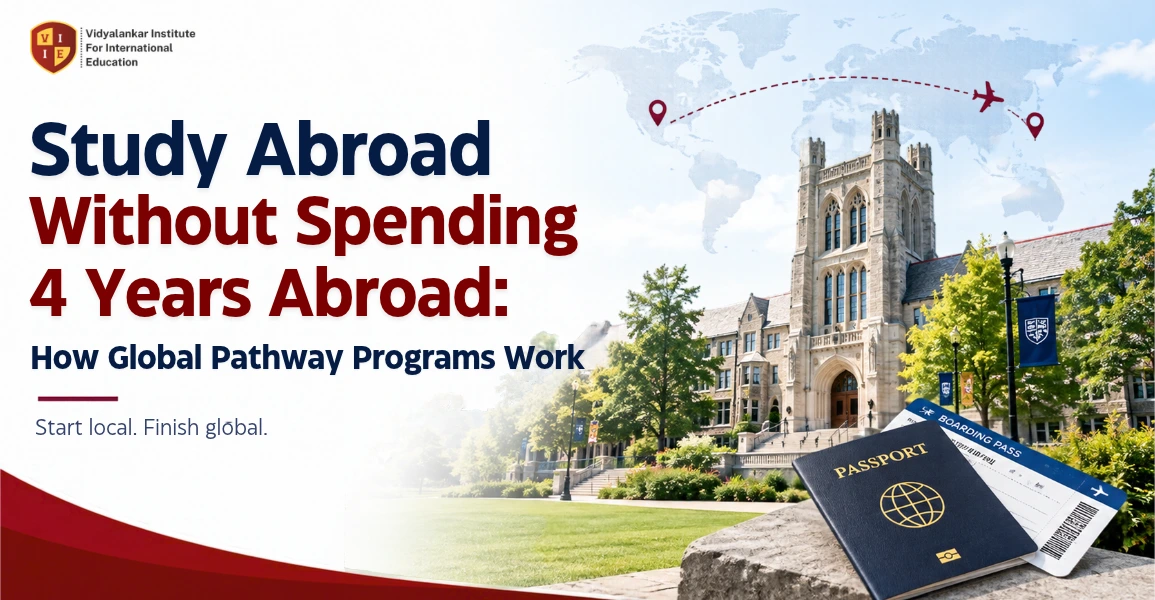
Study Abroad Without Spending 4 Years Abroad: How Global Pathway Programs Work
Dreaming of a degree from a global university but not excited about paying international fees for four full years?
What Is a Global Pathway Program?
A Global Pathway Program lets you split your degree between two places. You begin your studies in India, then move to a partner university abroad to complete the rest. In simple terms:
- You start your academic journey in India.
- You complete the first part of your program here.
- You then transfer to a partner university overseas for the remaining part, depending on the program.
- You can eventually graduate with a degree from the international partner university, subject to the program and university requirements.
How Does a Global Pathway Program Work?
The details differ by course and university, but the journey usually looks like this:
- Choose a program and destination. Pick a course and a partner university that match your interests and career goals.
- Begin your studies in India. You complete the first phase of your degree in India, building a strong academic foundation.
- Prepare for the transition. Towards the end of the Indian phase, you get ready for the move. This usually means meeting the partner university’s requirements and completing the necessary application and documentation steps.
- Continue your degree abroad. You join the partner university and complete the remaining part of your program.
Pathway programs come in different formats. A 2+2 structure means two years in India followed by two years abroad. Other structures may exist depending on the course and university, so always check the exact format before you apply.
Why Study Abroad for Only Part of Your Degree?
Spending part of your degree in India can make international education more manageable. The main advantages are:
- Lower overall costs. Studying part of your program in India can reduce total education and living expenses compared with spending the whole degree overseas. The actual saving depends on the program, university and destination, so ask for a program-specific cost breakdown.
- International academic exposure. You study at a global university and learn alongside students from different countries.
- Life abroad. You experience a new country, culture and classroom style.
- A smoother transition. You settle into university life at home first, then move abroad with more clarity and confidence.
- Global career exposure. Time at an international university can widen your learning and your professional network.
Is a Global Pathway Program Right for You?
This route may suit you if you:
- Want an international degree
- Are worried about the cost of studying abroad
- Prefer to begin your journey in India before moving overseas
- Want international exposure without spending the entire degree abroad
It may be less suitable if you want to spend all your years on an overseas campus from day one. Think about what matters most to you: budget, comfort, flexibility or the full abroad experience.
Study Abroad Without Spending Four Years Abroad
You don’t always have to choose between studying entirely in India and spending four full years overseas. A pathway program can create a middle route.
Vidyalankar Institute for International Education (VIIE) offers Global Pathway Programs through partnerships with universities in the USA, UK, Canada, Australia and New Zealand. VIIE’s undergraduate and postgraduate programs cover Engineering, Business and Media, and students split their program between India and a partner university abroad.
Whichever destination you consider, here are a few smart questions to ask:
- Which partner universities are available for my course?
- What is the pathway structure (for example, 2+2)?
- What are the eligibility and transfer requirements?
- What will the fees and living costs be in India and abroad?
Final Thoughts
If studying abroad has always felt financially out of reach, a Global Pathway Program could be worth exploring. Start in India, gain international exposure and take your next academic step abroad with a structured plan.
Explore VIIE’s Global Pathway Programs or connect with our counsellors to find a pathway that fits your academic goals.
Connect with us today:
Facebook
Twitter
LinkedIn
WhatsApp